
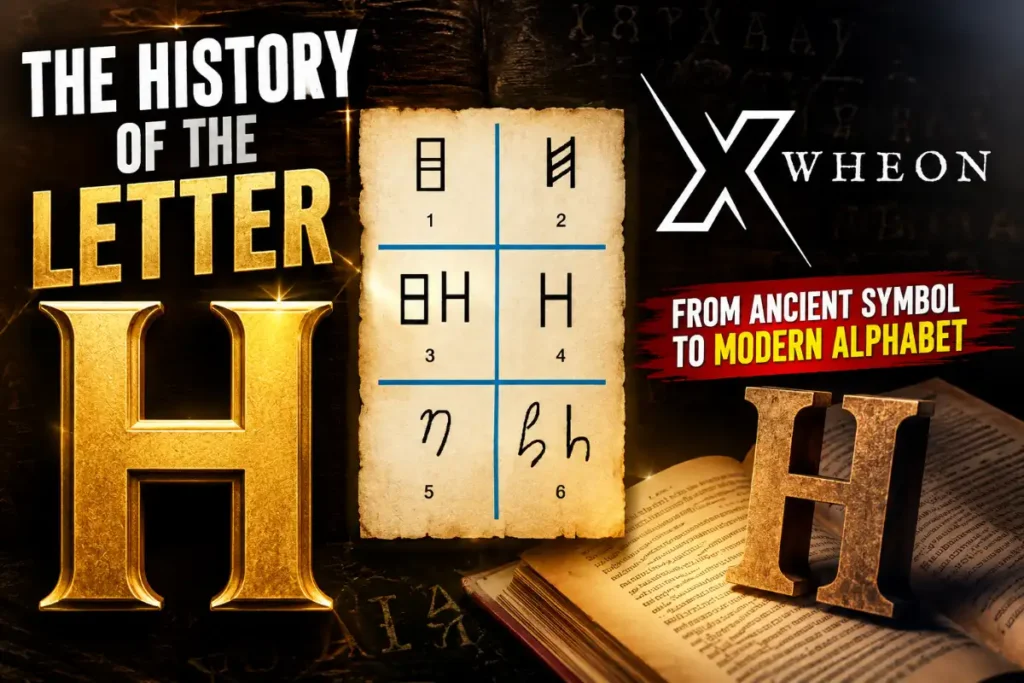

The letter H is one of the most commonly used letters in the English alphabet. It is the eighth letter and appears in thousands of words we use every day, such as “house,” “happy,” “human,” and “history.” Even though it looks simple, the letter H has a very long and interesting history that goes back thousands of years.
Over time, the sound, shape, and use of H changed across different languages and civilizations. In some languages, the letter is strongly pronounced, while in others it is completely silent. Today, H is not only important in language but also in science, especially chemistry, where it is used as the symbol for hydrogen.
In this article, we will understand the meaning of H, its origin, history, pronunciation, uses in different languages, and some interesting facts related to this important alphabet letter.
What Is the Letter H?
H is the eighth letter of the modern English alphabet. It is generally considered a consonant letter and is usually pronounced with a soft breath sound.
In uppercase form it is written as:
- H
In lowercase form it is written as:
- h
The sound of H can be heard clearly in words like:
- Hat
- Home
- Heart
- Horse
However, in some English words, the H remains silent.
For example:
- Honest
- Hour
- Heir
- Honour
This makes the letter H quite unique compared to many other letters.
Origin and History of the Letter H
The history of H goes back to ancient civilizations. The letter is believed to have originated from an old Semitic letter called “Cheth.” Early symbols related to H may have represented a fence or enclosure.
Later, the Greeks adopted this symbol into their alphabet. In ancient Greek writing, the letter appeared in different forms. One common version looked very similar to the modern capital H we use today.
The Greek alphabet later influenced the Etruscan and Latin alphabets. From there, the letter H became part of the Roman writing system, which eventually developed into the English alphabet.
So the H used today mainly comes from the Latin alphabet.
How the Shape of H Changed Over Time
In ancient times, letters were written by hand using simple tools and ink. Because of this, the shapes of letters slowly changed over centuries.
The early forms of H looked more decorative and handwritten. Later, during the Roman and medieval periods, scribes created smoother and faster writing styles.
The lowercase “h” developed from cursive handwriting styles where writers tried to lift the pen less often while writing. Over time, this evolved into the modern small letter h we use today.
Even though the design changed slightly in different regions, the basic structure of H remained surprisingly stable.
Pronunciation of H in English
In English, the letter H is usually pronounced with a breathy sound. It is produced by pushing air lightly out of the mouth.
Examples include:
- Hill
- Hand
- Hope
- Hungry
But English also contains many words where H is silent.
Words With Silent H
| Word | Pronunciation |
|---|---|
| Hour | Our |
| Honest | Onest |
| Heir | Air |
| Honour | Onour |
These silent H words mainly entered English from French and other Romance languages.
In spoken English, especially in fast conversations, people sometimes drop the H sound naturally. For example:
- “What did he say?”
may sound like: - “What did ’e say?”
This is common in casual speech.
H in Different Languages
The use of H changes greatly across languages.
English
In English, H is partly pronounced and partly silent depending on the word.
French
In French, the letter H is usually silent. Many French words begin with H but the sound is not spoken.
Example:
- Homme
- Hôtel
Spanish
In Spanish, H is generally silent.
Example:
- Hola
- Hombre
German
German strongly pronounces the H sound in many words.
Italian
In Italian, H is mostly silent but is often used to change pronunciation rules with other letters.
For example:
- “chi”
- “ghetto”
Here H helps create a harder sound.
Importance of H in Science
The letter H is very important in chemistry because it represents the chemical element Hydrogen.
Hydrogen is the lightest and most abundant element in the universe.
In chemistry:
- H = Hydrogen
Hydrogen is used in:
- Water molecules (H₂O)
- Fuel technology
- Industrial processes
- Space science
Without hydrogen, life on Earth would not exist because water contains hydrogen atoms.
Interesting Facts About the Letter H
The letter H has many unique features that make it interesting.
1. H Is One of the Oldest Letters
The history of H goes back thousands of years to ancient Semitic writing systems.
2. It Is Silent in Many Words
Unlike most letters, H often appears in spelling but is not pronounced.
3. H Changes Pronunciation
Sometimes H works with other letters to create new sounds.
Examples:
- sh
- ch
- th
- ph
4. It Is Important in Science
The symbol H is widely recognized in chemistry because of hydrogen.
5. H Is Common in English
Many everyday English words begin with H, making it one of the most frequently used letters.
H in Modern Communication
Today, the letter H is used everywhere:
- Text messages
- Books
- Social media
- Scientific formulas
- Brand names
- Computer programming
Even internet slang sometimes uses H in shortened forms like:
- “HBD” for Happy Birthday
- “HMU” for Hit Me Up
This shows how letters continue evolving with modern communication styles.
Difference Between Capital H and Small h
| Capital Letter | Small Letter |
|---|---|
| H | h |
Capital H is generally used:
- At the beginning of sentences
- For names
- For titles
Lowercase h is used in normal word writing.
Why the Letter H Is Important
Even though H may seem like just another alphabet letter, it plays a major role in language and communication. It helps form words, affects pronunciation, and even carries scientific meaning.
The letter also shows how languages evolve over time. From ancient symbols to modern English spelling, H has traveled through many civilizations and writing systems.
Final Thoughts
The letter H has a rich and fascinating history that stretches back thousands of years. From ancient Semitic symbols to Greek and Latin alphabets, H slowly evolved into the modern form we use today.
It is an important part of the English language and appears in countless words. Sometimes it is pronounced clearly, while in other cases it remains completely silent. Beyond language, H is also widely known in chemistry as the symbol for hydrogen.
Although it may look like a simple letter, H carries deep historical, linguistic, and scientific importance that continues even in modern times.