
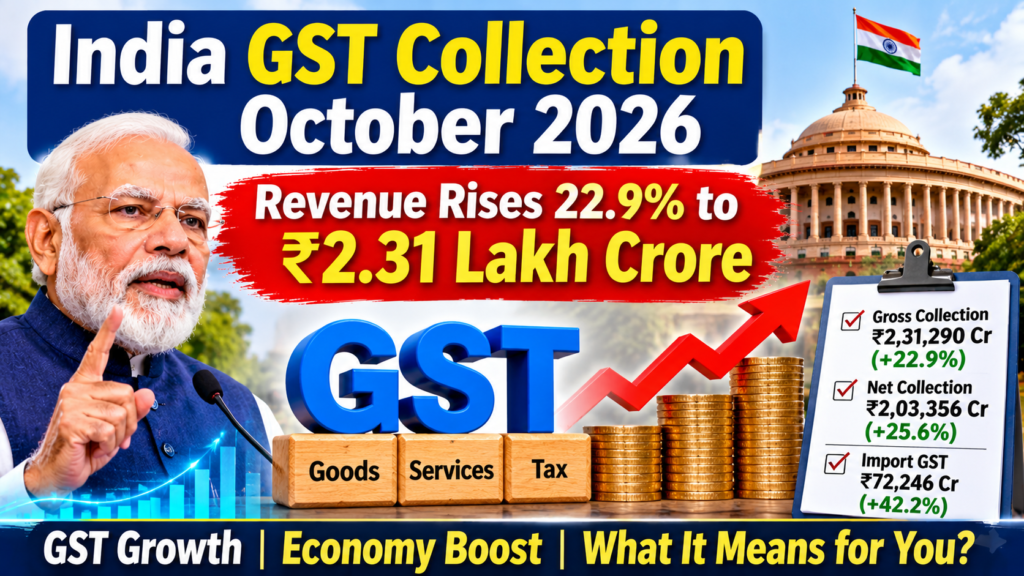

India’s Goods and Services Tax (GST) collection recorded impressive growth in October 2026, providing a positive signal for the country’s economy and tax revenue system. According to provisional government data released on November 1, India collected ₹2,31,290 crore in gross GST revenue during the month, marking a 22.9% increase compared with October 2025.
The latest figures are particularly significant because GST revenue crossed the ₹2 lakh crore mark for the fourth consecutive month. Strong import-related tax collections played a major role in this growth, while domestic GST revenue also recorded a healthy increase.
After adjusting for refunds, net GST collection stood at ₹2,03,356 crore, showing growth of 25.6% compared with the same month last year.
The October figures highlight the strength of India’s tax collection system, business activity and international trade. However, the sharp rise in import-related revenue also raises questions about the balance between domestic manufacturing and imported goods.
In this article, we explain India’s October 2026 GST collection, the reasons behind the increase, state-wise performance, the impact on businesses and what the latest figures could mean for the Indian economy.
India GST Collection October 2026: Key Highlights
The October 2026 GST figures reveal several important developments.
Here are the major highlights:
- Gross GST collection: ₹2,31,290 crore
- Year-on-year growth: 22.9%
- Net GST collection: ₹2,03,356 crore
- Net revenue growth: 25.6%
- Domestic GST revenue: ₹1,59,044 crore
- Domestic revenue growth: 15.8%
- Import-related GST revenue: ₹72,246 crore
- Import revenue growth: 42.2%
- Total refunds: ₹27,934 crore
- Refund growth: 6.5%
These figures show that both domestic transactions and imports contributed to the increase. However, import-related GST revenue grew considerably faster than revenue from domestic transactions.
1. Gross GST Collection Reaches ₹2.31 Lakh Crore
India’s gross GST collection increased to ₹2,31,290 crore in October 2026, compared with ₹1,88,125 crore in October 2025.
This represents year-on-year growth of 22.9%, making October one of the strongest months for GST revenue since the tax system was introduced in July 2017.
The collection was also the second-highest monthly tally on a comparable basis, behind April 2026, when gross GST revenue reached approximately ₹2.43 lakh crore.
Another important development is that GST collections remained above ₹2 lakh crore for four consecutive months. This indicates that the government’s monthly tax revenue has maintained a relatively strong level.
However, a single month’s collection should not be treated as proof of long-term economic growth. GST revenue is influenced by several factors, including consumer demand, business transactions, imports, tax compliance and the timing of payments.
The October figures therefore provide an encouraging picture, but the coming months will help determine whether this momentum continues.
2. Why Did GST Collection Increase in October 2026?
The increase in GST revenue was supported by two major sources: domestic economic transactions and imported goods.
Domestic GST revenue increased by 15.8% to ₹1,59,044 crore. Meanwhile, import-related GST revenue jumped by 42.2% to ₹72,246 crore.
The difference between these growth rates is important. It shows that imports contributed significantly to the overall increase in October’s tax collection.
Several factors can influence GST revenue:
Higher business activity: When companies sell more goods and services, their taxable transactions can increase.
Festive-season demand: October is an important period for shopping, retail sales, electronics, clothing, automobiles and other consumer products in India.
Import activity: GST collected on imported goods can increase when import values or volumes rise.
Tax compliance: Better reporting, digital invoicing and improved tax administration can help the government collect taxes more efficiently.
Business transactions: Manufacturing, wholesale trade, logistics and service-sector activities also contribute to GST revenue.
It is important to remember that the October GST figures largely reflect business transactions undertaken during September. Therefore, the collection is not a direct measurement of all purchases made by consumers during October.
3. Import-Related GST Revenue Records 42.2% Growth
One of the biggest highlights of October 2026 was the sharp increase in GST revenue from imports.
Import-related GST collections reached ₹72,246 crore, compared with ₹50,796 crore in October 2025. This represents growth of 42.2%.
Imports contributed approximately 31% of the month’s gross GST collection.
India imports various products and materials, including electronic components, industrial machinery, chemicals, raw materials and other goods required by businesses.
When taxable imports enter the country, applicable GST and related integrated tax collections contribute to government revenue.
The increase in import-related collections may reflect higher import values, increased shipments or changes in the composition of imported products. The headline figures alone do not establish which factor was responsible for the entire increase.
This development also highlights an important economic question.
India has been working to strengthen domestic manufacturing and reduce unnecessary dependence on imported products. Strong import-related GST revenue is positive for tax collection, but policymakers also need to encourage domestic production, investment and employment.
A balanced approach can help India benefit from international trade while strengthening its own manufacturing sector.
4. Domestic GST Revenue Also Shows Healthy Growth
Although imports recorded faster growth, domestic transactions continued to make up the larger share of India’s GST revenue.
Domestic GST collections reached ₹1,59,044 crore in October 2026, registering 15.8% growth compared with the previous year.
This is an encouraging sign because domestic GST revenue is connected with taxable economic activity within the country.
It includes transactions involving manufacturers, retailers, wholesalers, service providers and other registered businesses.
Growth in domestic collections can be supported by:
- Increased sales of consumer products.
- Higher demand for services.
- Expansion of manufacturing activities.
- Improved business reporting.
- Better tax compliance.
- Growth in wholesale and retail transactions.
However, GST revenue alone cannot explain the complete condition of the Indian economy. Employment, household income, inflation, investment and industrial production are also important indicators.
The domestic collection figures should therefore be considered alongside other economic data.
5. Net GST Collection Crosses ₹2 Lakh Crore
Another major development was the increase in net GST revenue.
Gross GST collection represents the total revenue collected before refunds are deducted. Net GST collection provides the amount remaining after refunds have been accounted for.
In October 2026, the government processed refunds worth ₹27,934 crore.
After adjusting for these refunds, net GST revenue stood at ₹2,03,356 crore.
In October 2025, net GST collection was approximately ₹1,61,900 crore. This means net revenue increased by 25.6% year-on-year.
The growth in net revenue was higher than the increase in gross collection because refunds increased at a slower rate.
Total GST refunds rose by 6.5% compared with October last year.
Refunds are an important part of the GST system, particularly for exporters and businesses that have eligible input tax credits. Timely refunds can help businesses manage their working capital and maintain smoother operations.
Therefore, strong net revenue and efficient refund processing are both important for a healthy tax system.
6. State-Wise GST Collection Performance in October 2026
State-wise domestic GST revenue figures show that economic and tax collection performance varied across different parts of India.
Maharashtra remained one of the largest contributors to domestic GST collections.
Here are some important state-level figures reported for October 2026:
| State | Domestic GST collection | Year-on-year growth |
|---|---|---|
| Maharashtra | ₹35,150 crore | 13% |
| Karnataka | ₹15,922 crore | 18% |
| Gujarat | ₹13,516 crore | 16% |
| Haryana | ₹11,529 crore | 17% |
| Assam | ₹1,934 crore | 47% |
| Uttar Pradesh | — | 24% |
| Bihar | — | 24% |
| Madhya Pradesh | — | 29% |
| Jharkhand | — | 31% |
Assam recorded particularly strong growth of 47%, while Jharkhand and Madhya Pradesh also reported significant increases.
Uttar Pradesh and Bihar recorded growth of 24% each.
Maharashtra continued to lead in the absolute amount of domestic GST revenue among the states listed, reflecting its large industrial, commercial and services economy.
However, growth rates and total collection amounts tell different stories. A state with a smaller tax base can record a higher percentage increase without collecting more revenue than a larger state.
State-wise comparisons should therefore consider both the amount collected and the rate of growth.
7. What Does Rising GST Collection Mean for Businesses?
GST is an important part of India’s business environment. The October 2026 figures may provide useful information for companies, traders, manufacturers and service providers.
Higher GST collections can indicate stronger taxable transactions and improved compliance.
For businesses, the latest figures also highlight the importance of maintaining accurate financial records.
Companies should pay attention to:
GST registration: Businesses that meet the applicable legal requirements should maintain valid registration.
Return filing: GST returns should be filed within the prescribed deadlines.
Invoice management: Correct invoices help reduce errors and support proper tax reporting.
Input Tax Credit: Businesses should check their eligibility and reconcile input tax credit with relevant records.
Refund claims: Exporters and other eligible businesses should monitor refund applications and maintain supporting documents.
Businesses should not assume that higher national GST collection automatically means higher profits. Tax revenue can increase even when individual companies face rising costs or weaker margins.
The real impact depends on each industry’s sales, expenses, competition and customer demand.
8. How Could the October GST Numbers Affect Common People?
Many people may wonder whether rising GST collections mean that everyday products will become more expensive.
The answer is not necessarily.
GST collection is a measure of tax revenue generated through taxable transactions. It does not automatically mean that GST rates have increased.
The price of a product depends on several factors, including its GST rate, manufacturing cost, transportation expenses, raw material prices, retailer margins and market demand.
For example, if more people purchase taxable products during a festive shopping period, the government may collect more GST even if the applicable tax rates remain unchanged.
Similarly, an increase in import-related GST revenue does not mean that every imported product has become more expensive.
Consumers should distinguish between three separate developments:
- An increase in GST collection.
- A change in GST tax rates.
- An increase in the market price of a product.
These developments can be connected, but they are not the same.
For households, the most important questions remain whether prices are rising, whether purchasing power is improving and whether employment and income opportunities are expanding.
9. GST 2.0 Reforms and Their Role in Tax Collection
India’s GST framework has continued to evolve since its introduction in July 2017.
The GST reform process has focused on simplifying tax structures, improving compliance and reducing difficulties for businesses.
The GST Council’s September 2025 decisions introduced a simplified two-main-slab structure of 5% and 18%, alongside a special 40% rate for specified luxury and sin goods.
These changes were intended to simplify taxation for many categories of products and services.
Further measures discussed by the GST Council in 2026 have also focused on making tax administration easier.
Simplified registration, improved refund processing and clearer compliance procedures can help businesses understand their responsibilities.
A more efficient GST system can benefit both the government and taxpayers.
For the government, better compliance can improve revenue collection. For businesses, simpler procedures can reduce administrative difficulties and make tax planning easier.
The long-term success of GST reforms will depend on how effectively these changes are implemented across states and industries.
10. April–October 2026 GST Collection Shows Strong Overall Growth
October’s performance was not the only positive development.
During the first seven months of financial year 2026–27, from April to October, India’s gross GST collection reached approximately ₹14.78 lakh crore.
This represented 13.2% growth compared with approximately ₹13.05 lakh crore during the same period of the previous financial year.
Net GST collection during April–October increased by 12.6% to approximately ₹12.69 lakh crore.
These cumulative figures are important because they provide a broader picture than one month’s revenue.
October’s strong growth helped support the overall performance of the financial year so far.
However, the difference between gross and net collection remains important. Refunds are a normal part of the tax system, and businesses need timely refunds to maintain healthy cash flow.
The government’s challenge is to maintain strong revenue collection while ensuring that compliance remains practical for businesses of different sizes.
11. Challenges That India Must Address
Although the October GST figures are encouraging, India’s tax system still faces several challenges.
Complex compliance: Smaller businesses may find GST documentation, return filing and reconciliation difficult.
Refund delays: Delayed refunds can create working-capital pressure, particularly for exporters.
Uneven state performance: Different states have different industrial structures, consumption levels and tax bases. Their revenue growth can therefore vary significantly.
Dependence on imports: Rapid growth in import-related revenue highlights the importance of strengthening domestic manufacturing.
Business awareness: Some small traders and new entrepreneurs still need better understanding of GST rules and compliance procedures.
Addressing these challenges can make the GST framework more effective.
The goal should not only be to increase tax collection but also to create a transparent and business-friendly tax environment.
12. What Can We Expect from GST Collection in the Coming Months?
The October 2026 figures have created positive expectations for the remaining months of FY2026–27.
Festive demand, business activity and imports may continue to influence GST revenue.
The coming months will be particularly important because the government will be able to assess whether the strong October performance continues.
Several factors could influence future collections:
- Consumer demand during the festive and wedding seasons.
- Manufacturing and industrial production.
- Imports of raw materials and finished products.
- Changes in international trade conditions.
- Tax compliance and return filing.
- Refund processing and administrative reforms.
However, it would be premature to predict that every upcoming month will record similar growth.
Monthly GST revenue can change because of seasonal demand, business cycles, import movements and other economic conditions.
Consistent growth over several months would provide stronger evidence of sustained revenue momentum.
Frequently Asked Questions (FAQs)
1. What was India’s GST collection in October 2026?
India’s gross GST collection reached ₹2,31,290 crore in October 2026, registering 22.9% growth compared with October 2025.
2. What was the net GST collection in October 2026?
Net GST collection after adjusting for refunds stood at ₹2,03,356 crore, showing year-on-year growth of 25.6%.
3. Why did GST collection increase in October 2026?
The increase was supported by domestic GST revenue growth of 15.8% and a 42.2% rise in import-related GST revenue.
4. How much GST revenue came from imports?
Import-related GST revenue reached ₹72,246 crore in October 2026, compared with ₹50,796 crore in October 2025.
5. Which state recorded strong GST growth in October 2026?
Assam recorded 47% growth in domestic GST revenue, among the strongest increases reported for states.
6. Does higher GST collection mean that GST rates have increased?
No. Higher GST collection does not automatically mean that tax rates have increased. Revenue can rise because of higher taxable sales, imports, business activity or improved compliance.
7. What was India’s GST collection from April to October 2026?
Gross GST collection during April–October FY2026–27 reached approximately ₹14.78 lakh crore, showing 13.2% growth year-on-year.
Conclusion: India’s GST Revenue Shows Strong Momentum
India’s GST collection of ₹2,31,290 crore in October 2026 represents a significant increase in government tax revenue.
The 22.9% year-on-year growth, combined with net revenue growth of 25.6%, highlights strong revenue mobilisation. Domestic transactions contributed positively, while the sharp increase in import-related GST revenue played a major role in the overall performance.
The cumulative April–October figures also indicate that GST revenue has maintained healthy growth during the first seven months of FY2026–27.
At the same time, the latest numbers highlight important priorities for the Indian economy. Strengthening domestic manufacturing, improving tax compliance, simplifying procedures and ensuring timely refunds will remain essential.
For businesses, the figures underline the importance of accurate GST reporting and financial planning. For consumers, they provide an economic indicator rather than direct evidence of an increase in everyday prices.
Overall, October 2026 has been a strong month for India’s GST revenue system. The next few months will show whether this momentum can continue and contribute to sustainable economic growth.
This article is based on provisional GST collection figures reported on November 1, 2026. Figures may be subject to official updates.